Reading Worksheets
Short, original reading passages for young readers, each followed by comprehension questions that check understanding of details, sequence, vocabulary and the main idea. The pack mixes stories and nonfiction from grade 1 to grade 3 levels, with answer keys, a graphic organiser and a reading log.
Reading Comprehension Worksheets (Grades 1–3)
Five original reading passages (stories and nonfiction) with comprehension questions and answer keys, a story map organiser and a reading log.
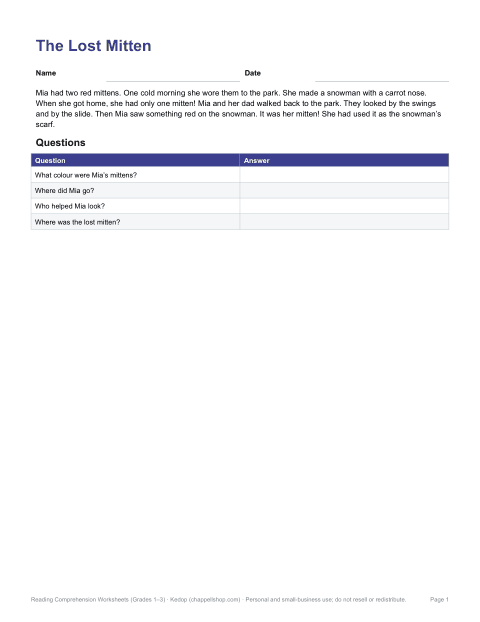
- The Lost Mitten (Grade 1)
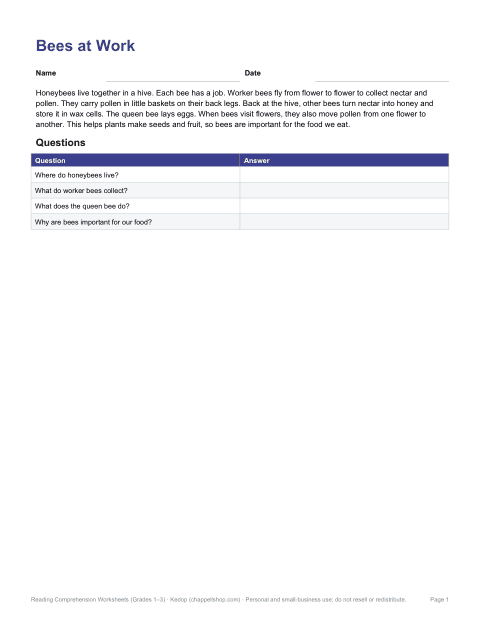
- Bees at Work (Grade 2)
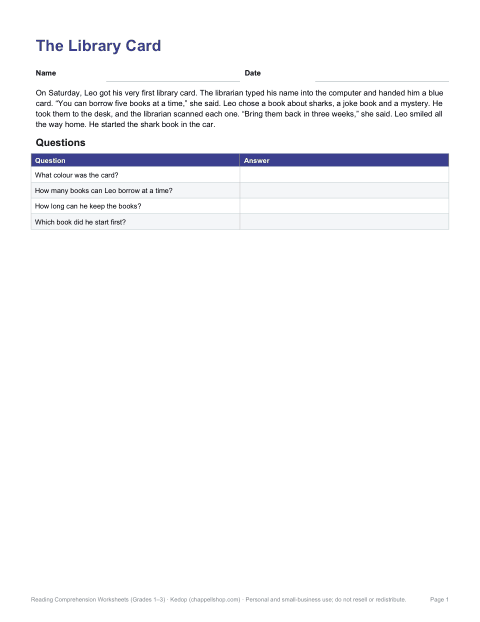
- The Library Card (Grade 2)
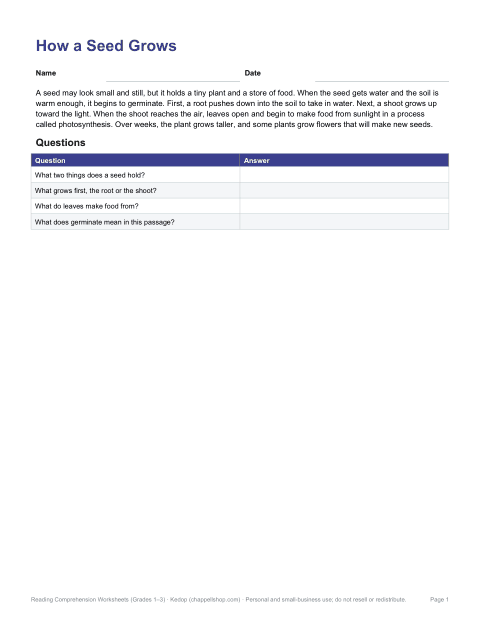
- How a Seed Grows (Grade 3)
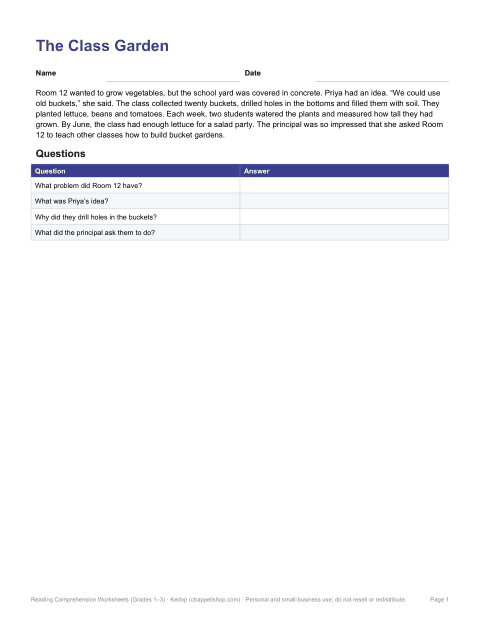
- The Class Garden (Grade 3)
- Story map organiser (PDF, DOCX)
- Reading log (PDF, DOCX, XLSX)
Formats: PDF, DOCX, XLSX. Instant download after payment (link valid 72 hours, up to 5 downloads). AI-assisted: the templates were drafted with AI help and reviewed and laid out by Kedop.
$5.00 USD, one-time
Secure card checkout by Stripe. Full refund within 7 days — see the refund policy and license.
Passages in the pack
| Title | Level | Type | Focus |
|---|---|---|---|
| The Lost Mitten | Grade 1 | Story | Details and sequence |
| Bees at Work | Grade 2 | Nonfiction | Main idea and vocabulary |
| The Library Card | Grade 2 | Story | Details and sequence |
| How a Seed Grows | Grade 3 | Nonfiction | Main idea and vocabulary |
| The Class Garden | Grade 3 | Story | Problem and solution |
Each passage is written for this pack and kept short enough to read in one sitting, with vocabulary suited to its level.
Sample passage: The Lost Mitten (grade 1)
Mia had two red mittens. One cold morning she wore them to the park. She made a snowman with a carrot nose. When she got home, she had only one mitten! Mia and her dad walked back to the park. They looked by the swings and by the slide. Then Mia saw something red on the snowman. It was her mitten! She had used it as the snowman’s scarf.
Questions: What colour were Mia’s mittens? Where did Mia go? Who helped Mia look? Where was the lost mitten?
Types of comprehension questions
| Question type | What it checks | Example |
|---|---|---|
| Literal (right there) | Finding details stated in the text | Where do honeybees live? |
| Sequence | Order of events or steps | What grows first, the root or the shoot? |
| Vocabulary in context | Working out word meaning from clues | What does germinate mean in this passage? |
| Inference | Reading between the lines | Why did they drill holes in the buckets? |
| Main idea | What the passage is mostly about | Why are bees important for our food? |
How to use the worksheets
- Preview the title and ask children to predict what the passage is about.
- Read the passage together or have children read independently.
- Read it a second time for fluency — rereading builds confidence and speed.
- Answer the questions, looking back in the text to find evidence.
- Discuss answers, especially inference questions where reasoning matters.
- Record the reading in the reading log.
Encourage children to underline the sentence in the passage that answers each literal question. Finding evidence is a key comprehension skill.
Supporting struggling readers
- Read the passage aloud first, then have the child read it back.
- Pre-teach tricky words such as “germinate” or “librarian”.
- Answer questions orally before writing.
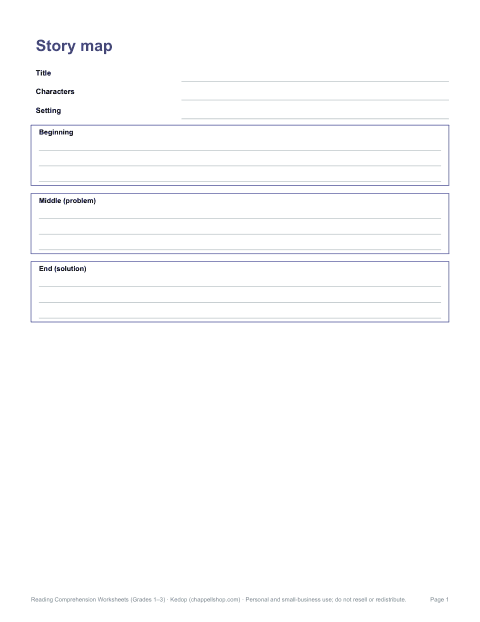
- Use the graphic organiser to map beginning, middle and end.
- Choose a lower-level passage and build up.
Who it is for
Teachers of grades 1–3, reading specialists, tutors, homeschooling families and parents who want short, high-quality reading practice. The passages also work for English language learners at early intermediate levels.
Formats
Passages, questions and answer keys are print-ready PDFs (US Letter; print on A4) and editable Word files so you can adapt questions for your students.
Talking about the passage
Conversation deepens understanding. After reading, ask open questions that do not have one right answer: “What would you have done if you were Mia?”, “Which fact about bees surprised you?”, “How else could Room 12 have solved their problem?” Encourage children to use words from the passage in their answers. These discussions build the vocabulary and reasoning that make later reading easier.
Building reading stamina
Short passages are a starting point. As children become more fluent, pair each passage with a longer book on the same topic — a picture book about bees or a story about a library — and use the reading log to track minutes read each day. Daily reading at home, even ten to fifteen minutes, is one of the best predictors of reading progress.
Frequently asked questions
What grades are these reading worksheets for?
Grades 1–3.
Are the passages original?
Yes, they were written for this pack.
Are answer keys included?
Yes, for every passage.
Can I edit the questions?
Yes, the Word versions are editable.
Was AI used to create them?
The passages and questions were drafted with AI assistance and then reviewed, edited and formatted by Kedop.